The CORE Methodology: A Framework for Leaders Who Are Carrying a Lot and Still Showing Up Anyway
After 10 years of real conversations with leaders, professionals, and caregivers, the CORE Methodology is what worked and what was missing. A trauma-informed framework for leaders who are carrying a lot and still showing up anyway.

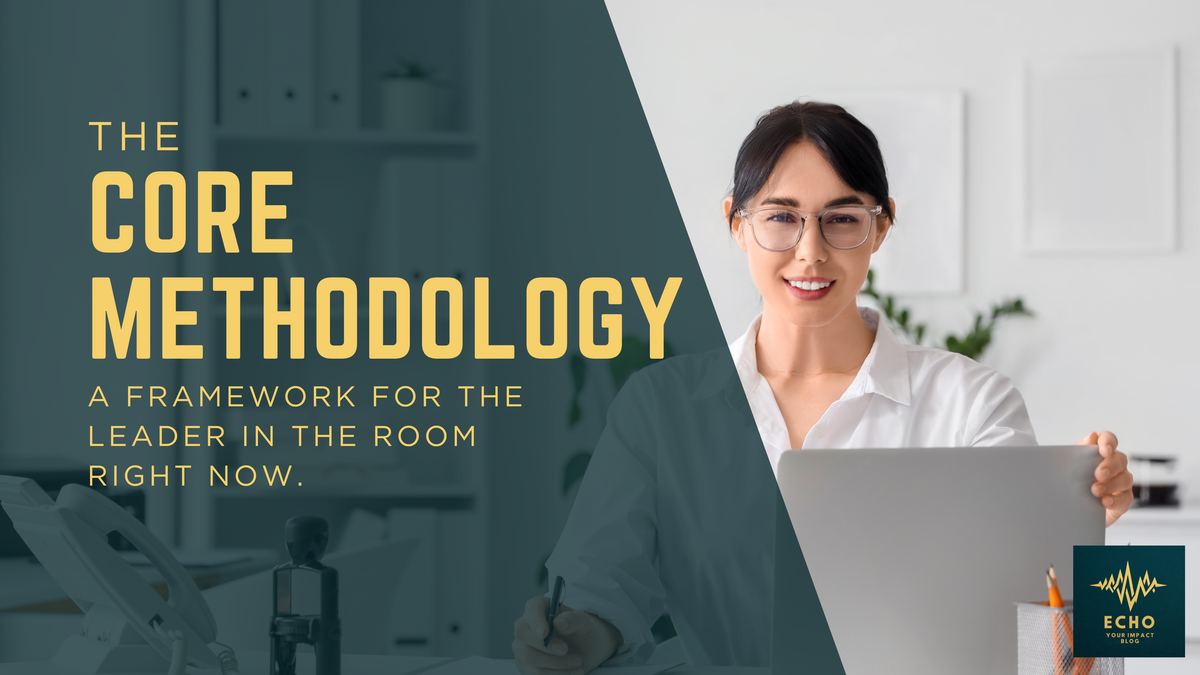
The CORE Methodology is an original framework developed by Kimberly Perez, MBA, TICC, and is the foundation of all coaching, consulting, and speaking engagements offered through Echo Your Impact, LLC.The CORE Methodology is an original framework developed by Kimberly Perez, MBA, TICC, and is the foundation of all coaching, consulting, and speaking engagements offered through Echo Your Impact, LLC.
If you are reading this, there is a good chance you are a good leader. Skilled, committed, genuinely caring about the people around you. And also, if you are honest, exhausted in a way that a weekend off does not fix.
That is not a character flaw. That is a signal.
I built the CORE Methodology after ten years of direct work with leaders, professionals, military families, trauma survivors, and caregivers. Hundreds of conversations. Hundreds of moments where I watched capable, committed people burning out not because they were doing it wrong, but because no one had ever given them a framework for the parts of the work that do not show up in a job description.
I kept seeing the same gaps. The same invisible weight. The same patterns of people giving everything to their teams, their organizations, and their families while quietly losing themselves in the process.
CORE is what worked. And it is what was missing.
What CORE Is and What It Is Not
Before I walk you through the four pillars, I want to be clear about what this is not.
This is not a productivity system. It will not help you fit more into your calendar. It is not a performance optimization tool, and it is not another set of metrics to measure yourself against.
What it is: a framework rooted in trauma-informed and whole-person coaching principles. It starts from the assumption that every person in the room, including you, is a full human being first. Leading well over time requires being honest about what you are carrying, boundaried enough to be sustainable, and grounded enough to actually reflect your values.
It is designed to be useful on its own. You can read through these pillars, sit with the questions they raise, and start applying them to your own leadership today. No coach required. If at some point you want more, group courses, workshops, and one-on-one support are available. But the framework itself is meant to be a tool you can actually use, not a teaser for something you have to buy first.
It works at the individual level, the team level, and the organizational level. But it always starts with you.
C — Courageous Conversations
Real leadership begins with honest language.
Courageous Conversations are not about conflict. They are not about being the boldest voice in the room or delivering hard feedback without flinching. They are about something harder and more important: creating the conditions where truth can actually be spoken.
Most leadership breakdowns are not strategy failures. They are communication failures. Specifically, the failure to have the conversation that everyone in the room knows needs to happen but no one is having.
The Courageous Conversations framework gives you a four-part structure for showing up fully in those moments:
- See every whole person in the room, including yourself. You cannot lead humans if you are treating them, or yourself, as a function.
- Name what is actually happening. Not the polished version. The real version.
- Communicate with boundaries, not barriers. There is a difference between protecting yourself and shutting people out. This step helps you find it.
- Build systems that reflect your values. The conversation is only the beginning. What structures will hold what you just said?
Courageous conversations are a skill. They can be practiced, taught, and built into your culture. But they start with a willingness to stop managing around the truth.
A question to sit with: What conversation have you been putting off that, if you had it, would change something important?
O — Overcome Invisible Load
Naming what you are actually carrying.
Every leader is carrying more than their job description.
Caregiving responsibilities. Chronic stress. Grief. Systemic pressure. The emotional labor of holding space for your team while quietly managing your own. The weight of decisions made in ambiguous conditions with incomplete information and real human consequences.
This is the invisible load. It is real whether you acknowledge it or not. It just shows up differently when you do not. It shows up as irritability, decision fatigue, emotional flatness, or that particular kind of tired that does not respond to sleep.
Overcoming the invisible load does not mean eliminating it. Some of it cannot be eliminated. It means naming it, getting honest about what you are carrying and how it is showing up in your leadership, and then building the capacity to carry it without it carrying you.
This is one of the most uncomfortable parts of the CORE work for high-achieving leaders. It requires admitting weight that our professional culture tells us we should not have. But in over a decade of this work, the leaders who do this consistently are more present, more decisive, and more sustainable over time. Not because they have less weight, but because they are no longer pretending it does not exist.
A question to sit with: What are you carrying right now that you have not named out loud to anyone?
R — Reclaim Your Boundaries
The structures that make sustainable leadership possible.
Somewhere along the way, the word "boundaries" got a reputation. It started to feel like a therapy term. Or a soft term. Or a term that meant you were not committed enough.
Let me reframe it.
Boundaries are not walls. They are the structures that make sustainable leadership possible. Without them, you are not more dedicated. You are more depleted. And depleted leaders do not make better decisions. They make faster ones.
Reclaiming your boundaries means getting honest about where you end and where your role begins. It means communicating that clearly, in ways that protect your energy without damaging your relationships. And it means understanding that saying no to the wrong things is what makes it possible to say yes to the right ones on purpose.
Most high-performers have never had permission to reclaim the ones they quietly gave away, to their team, their organization, or their own inner critic. This pillar is about taking that permission back.
A question to sit with: Where are you operating outside your own limits right now, and who told you that was required?
E — Evolve Through Aligned Action
Growth grounded in your values.
Growth that is not grounded in your values is just movement.
You can be busy and be completely off course. You can hit every metric and feel hollow. You can advance in your career and feel like you are getting further from yourself. That is misaligned growth, and it is more common than most leaders will admit out loud.
Evolving through aligned action means building the habits, systems, and decisions that actually reflect who you are and where you are going, not just who you think you are supposed to be. It is where the work of the first three pillars becomes something real and lasting.
This is not about perfection. It is not about a five-year plan with no room for detours. It is about moving intentionally, so that when you look back, what you built actually looks like you.
A question to sit with: If your calendar and your values sat down together, would they recognize each other?
The Goal Is Not a Leader Who Never Struggles
The CORE Methodology is not designed to produce leaders who never feel the weight of the work, never question whether they are doing it right, or never have a hard week.
The goal is a leader who knows what they are carrying and chooses to lead anyway. With clarity. With honesty. With boundaries intact and values in view.
That leader is more effective. More trusted. More human. And significantly more likely to still be standing, and still wanting to lead, five years from now.
This framework came from a decade of real conversations with real people navigating real pressure. It is not theoretical. It is what worked, distilled into something you can actually use.
How to Use This Framework
On your own: Start with the reflection questions at the end of each pillar. You do not need a coach to begin this work. Sit with them honestly and see what comes up.
In a group setting: CORE is available as a group course and workshop format, designed for teams, leadership cohorts, and organizational convenings. Working through this alongside others changes the conversation entirely.
In one-on-one support: If you are navigating something heavier, burnout, a major transition, a leadership challenge that feels bigger than a framework can hold, individual coaching is available on a select basis.
There is no wrong on-ramp. The right one is wherever you actually are.
Ready to Go Deeper?
Explore Services
Work With Kimberly
Kimberly Perez is a Trauma-Informed Certified Coach (TICC) and MBA-level consultant with over 10 years of experience at the intersection of human wellness and organizational strategy. She is the founder of Echo Your Impact, LLC and the host of Leadership Unfiltered. She works with individuals, leaders, and mission-driven organizations navigating burnout, transition, and sustainable growth.